

James Harris Named Gold Medalist Guitarist and Composer
When a musician is named a gold medalist, the simplest reaction is to assume this is the start of the story – a debut, a “breakout,” the beginning of a narrative the industry loves to tell about overnight success. In James Harris’ case, the medal arrives as something very different: a formal acknowledgement of a career, a sound, and a discipline that have been quietly maturing for years.
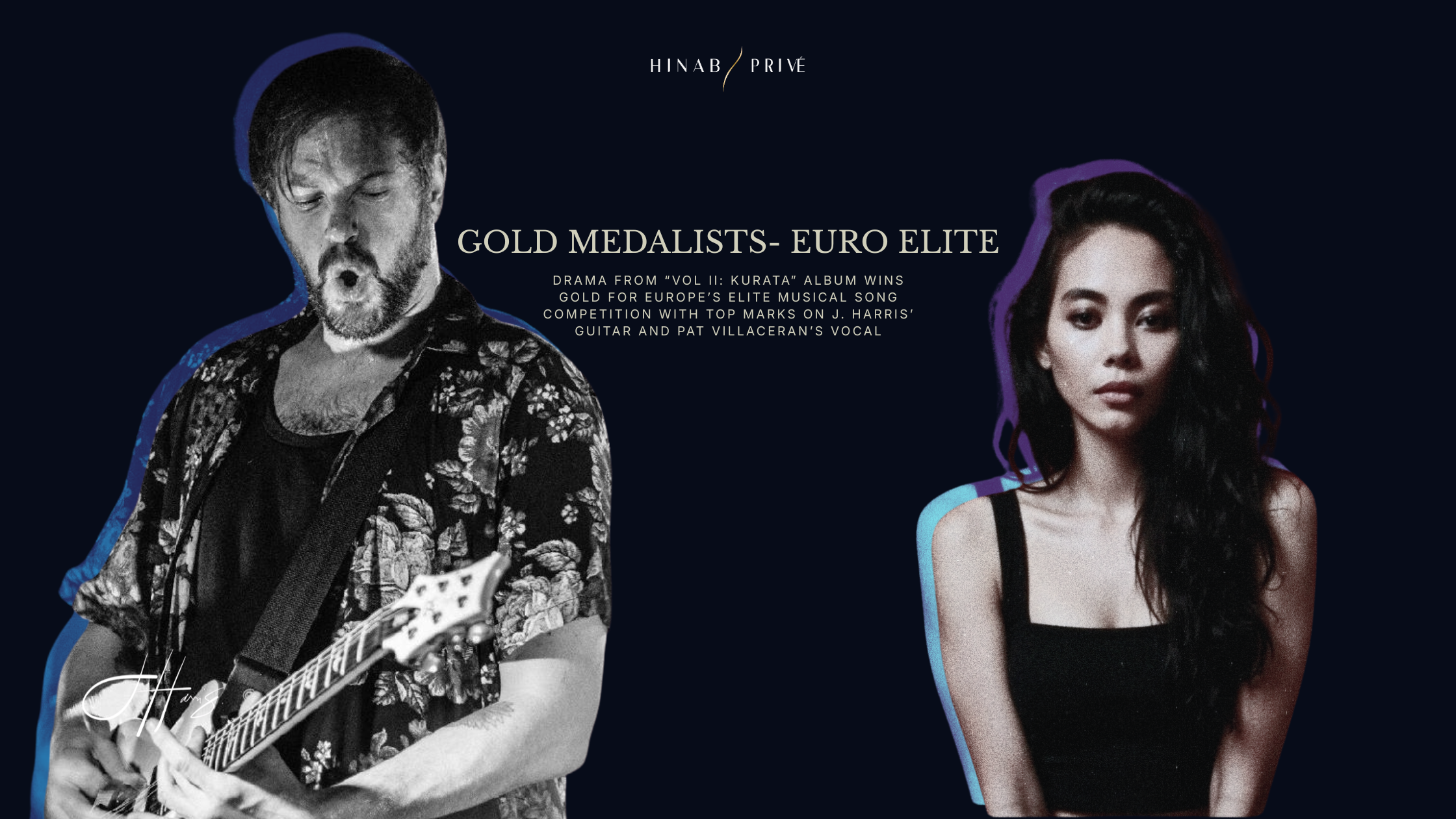
The Euro Elite Music Competition has awarded Harris its top honour for his work as guitarist and composer on “DRAMA,” one of the central tracks from the cinematic pop‑rock album VOL II: KURATA. To listeners who have been paying attention to the Hinabi Privé universe, the decision feels less like a surprise and more like a moment of alignment between institutions and reality. Harris has long played, written, and produced like someone who already knew what he was doing. Now there is a gold seal attached to that fact.
A Career Built the Long Way Around

Before there were medals, there was mileage. Harris’ musical life began in the most unglamorous fashion possible: two schoolmates, two guitars, and a willingness to write songs that were only partially jokes. Those early experiments evolved into two bands, four albums, and the kind of touring that doesn’t show up in highlight reels – long drives across the U.K. and Europe, small stages, unpredictable crowds, and a nightly reminder that songs have to work in imperfect conditions or they don’t really work at all.
That apprenticeship has shaped everything about his musical identity. Harris learned, early, that guitar parts are not just chances to show off; they are structural elements that make or break a song in the wild. Chord voicings and melodic fragments had to cut through cheap PAs and noisy rooms. Arrangements had to be tight enough that a tired band could still deliver them convincingly on a Wednesday night. In that environment, you either develop taste and restraint or you burn out. Harris chose the former.
The result is a guitar language that isn’t interested in pyrotechnics for their own sake. His playing is recognisable not because it is loudest or fastest, but because it is so clearly governed by an internal logic: lines that carry harmonic information, voicings that feel emotionally specific, dynamic shapes that echo the lyric rather than fight it. Long before any competition scorecards, that was the measure he held himself to.
From Acoustic Roots to Cinematic Rock
Harris has spent years studying and playing across genres. By his own account, he has tried “every style out there” at some point, not to become a chameleon, but to locate the parts that felt like his. Over time he gravitated toward acoustic work, treating it as the purest way to test whether a song could stand on its own. If a piece worked with nothing but voice and guitar, it earned the right to be dressed up; if it didn’t, no amount of production could save it.

That ethos is written all over VOL II: KURATA, the album that contains “DRAMA.” Even at its most expansive – the Bond‑coded opener “BUTTERFLIES,” the title track with its Asian‑inflected progressions, the widescreen emotional sweep of the final act – you can imagine every song being reduced back down to Harris, a guitar, and a microphone. The cinematic elements are there to serve that core, not distract from it.
“DRAMA,” the track that clinched the gold, is a textbook example of how those values translate into a modern production. Structurally, it’s lean: verses that waste no time, a pre‑chorus that tightens the screws without resorting to gimmicks, a chorus that lands with a sense of inevitability rather than surprise. The guitars do the heavy lifting, alternating between supportive textures and hooks that carry their own melodic weight. The arrangement is big enough to feel filmic, but focused enough that every element reads on first listen.
To competition judges used to hearing technically impressive but emotionally thin entries, that combination – craft and feeling in equal measure – is hard to ignore.
Composer, Producer, Architect
The “guitarist and composer” tag attached to Harris’ gold medal is important. It acknowledges that his role in Hinabi Privé’s work goes well beyond writing riffs or playing leads. He is one of the main architects of VOL II: KURATA’s three‑act structure: an album that traces a path from heartbreak through self‑interrogation to a hard‑won version of love that feels earned, not borrowed.
That structure isn’t just a marketing line. It is built into the key choices, motif placement, and pacing of the record. Harris’ compositional fingerprints are everywhere – in the way themes reappear in new guises, in the careful management of tension and release, in the decision to let some songs live in ambiguity rather than forcing quick resolutions. He writes with the full album in mind, not just the 30 seconds that might make a good social clip.

As a producer, he brings a similar discipline. The mixes on KURATA are cinematic but not bloated: drums that hit without flattening everything, guitars that occupy consistent lanes in the spectrum, strings and synths that widen the frame instead of filling every gap. You can hear that he designs with both headphones and live rooms in mind. It is the work of someone who understands that production is not about stacking as many sounds as possible, but about choosing which ones are essential.
A Gold Medal in a Larger Universe
Harris’ gold medal is not just a personal achievement; it is also a milestone for the wider Hinabi Privé project. The haus is building a polymathic cultural world: live ARCS that blend Filipino heritage, global influences, food, cocktails and story; fashion capsules that extend those stories into what people wear; and original music volumes that serve as both standalone records and scores for that universe.
Within that context, Harris’ recognition opens doors. It makes programmers, curators, and potential partners pay a different kind of attention. A gold medal tells gatekeepers: this work has been tested by ears outside the fanbase and found to be exceptional. That can translate into better festival slots, more serious media coverage, and a longer runway for future volumes.
For Harris, though, the medal does not rewrite his relationship to the work. If anything, it sharpens it. When you already knew you were good – because you had done the miles, written the songs, and built a sound that felt like yours – an award doesn’t redefine you. It confirms your trajectory and raises the stakes. The question becomes not “Am I deserving?” but “What can I build now that more people are watching?”
Why It Matters
In an era where “guitarist” can mean anything from loop‑based bedroom noodler to touring lifer, and “composer” is sometimes used for anyone who drags MIDI blocks around a grid, James Harris’ gold medal offers a clearer picture of what those titles can still signify. It stands for years of deliberate practice, a commitment to songs that work in real rooms, and a willingness to think about albums as longform statements in a short‑attention economy.
More than anything, it suggests that there is still room – and appetite – for musicians whose identities are built on craft rather than on moments. Harris has been that kind of artist for a long time. The Euro Elite judges have simply given the rest of the world a reason to say it out loud.
