

What the Gold Medal for DRAMA Means for James Harris in 2026

The gold medal for “DRAMA” lands in James Harris’ life at a very particular moment. Not at the teenage breakthrough stage, not as a late‑career lifetime achievement award, but right in the middle of building something bigger: a live band for VOL II: KURATA, a signature sound that finally feels wholly his, and a co‑writing partnership with Pat Villaceran that is reshaping what a “project” can be.
For Harris, the medal is less a crown and more a green light. It doesn’t tell him he’s good; it tells him the world is finally ready to meet the version of himself he has already been playing as for years.
From Contest Winner to Band Leader
The most immediate impact of the Euro Elite recognition is practical: it accelerates the case for building a live KURATA band at full scale.
“DRAMA” did not win as a bedroom experiment. It won because it sounds like a real band in a real room, playing a song that has been written, arranged, and produced with live performance in mind. The drums feel physical, the guitars carry both hook and harmony, the vocal line is built to be sung, not just stacked and tuned. A judging panel heard that and responded.
In 2026, that matters. Bookers, festival programmers, and sponsors often use awards as shorthand. A gold medal in a respected competition says, “You can trust this will land onstage.” For Harris and the Hinabi Privé team, that’s leverage. It strengthens every pitch to venues and partners: this isn’t just an interesting art‑house concept, it’s a show anchored by an award‑winning song and a fully written album beneath it.
The medal gives Harris permission – both externally and internally – to think like a bandleader rather than just a guitarist or producer. It supports decisions like:
Recruiting players who can match the album’s dynamics and feel, not just cover the chords.
Insisting on proper rehearsal time to translate the album’s three‑act arc into a set that breathes in rooms.
Designing a stage presentation that honours the cinematic weight of VOL II: KURATA instead of defaulting to “four people on stage, lights on, hope for the best.”
In other words, the gold turns “we should probably try a live set” into “we are building a live show worthy of this record.” It raises expectations – and gives Harris the backing to meet them.

Permission to Sound Like Himself
Awards can be dangerous for artists who are still looking for their identity. They can become a trap: “this sound worked, so I must never deviate from it.” For Harris, the situation is almost the reverse. The gold for “DRAMA” validates a sound he arrived at by ignoring a lot of prevailing pressures.
Harris’ path has been long and eclectic. He has played “every style out there” at some stage, not to brand himself as versatile, but to test which voices felt natural and which felt like costumes. Over time he narrowed toward a specific space: guitar‑forward, emotionally literate rock with strong melodic architecture and cinematic production choices. Not quite indie, not classic rock, not pop‑punk, not metal – a lane that borrows from all of them without belonging wholly to any.
That is a risky place to sit in a market that likes clean tags. A less secure artist might have shaved the edges off to match a trend: make the guitars more generic “alt,” flatten the arrangements into loop‑friendly grids, chase whatever spotifycore sound is getting added fastest this quarter.
Instead, Harris doubled down on what felt like his. On VOL II: KURATA, the guitar voicings are idiosyncratic: lots of harmonic information, carefully chosen inversions, a sense of phrasing that comes from playing in rooms, not just programming on screens. The songs lean into real dynamic shifts; there are quiet parts that are actually quiet and loud parts that feel earned. The mixes are big but not hyper‑compressed. It’s a sound built on taste and instinct more than on trend analysis.
The gold medal tells him – and the people around him – that this instinct is worth trusting. It says, “This is not too specific, too thoughtful, too album‑oriented to resonate.” The path he has chosen is not just artistically valid; it is competitive.
Practically, that means he can go deeper into his own language on future volumes and live shows. He doesn’t need to soften his tonal palette or simplify his structures to chase a notional wider audience. The wider audience just heard “DRAMA” and handed him a medal for sounding like himself.
Co‑Creating a World with Pat Villaceran
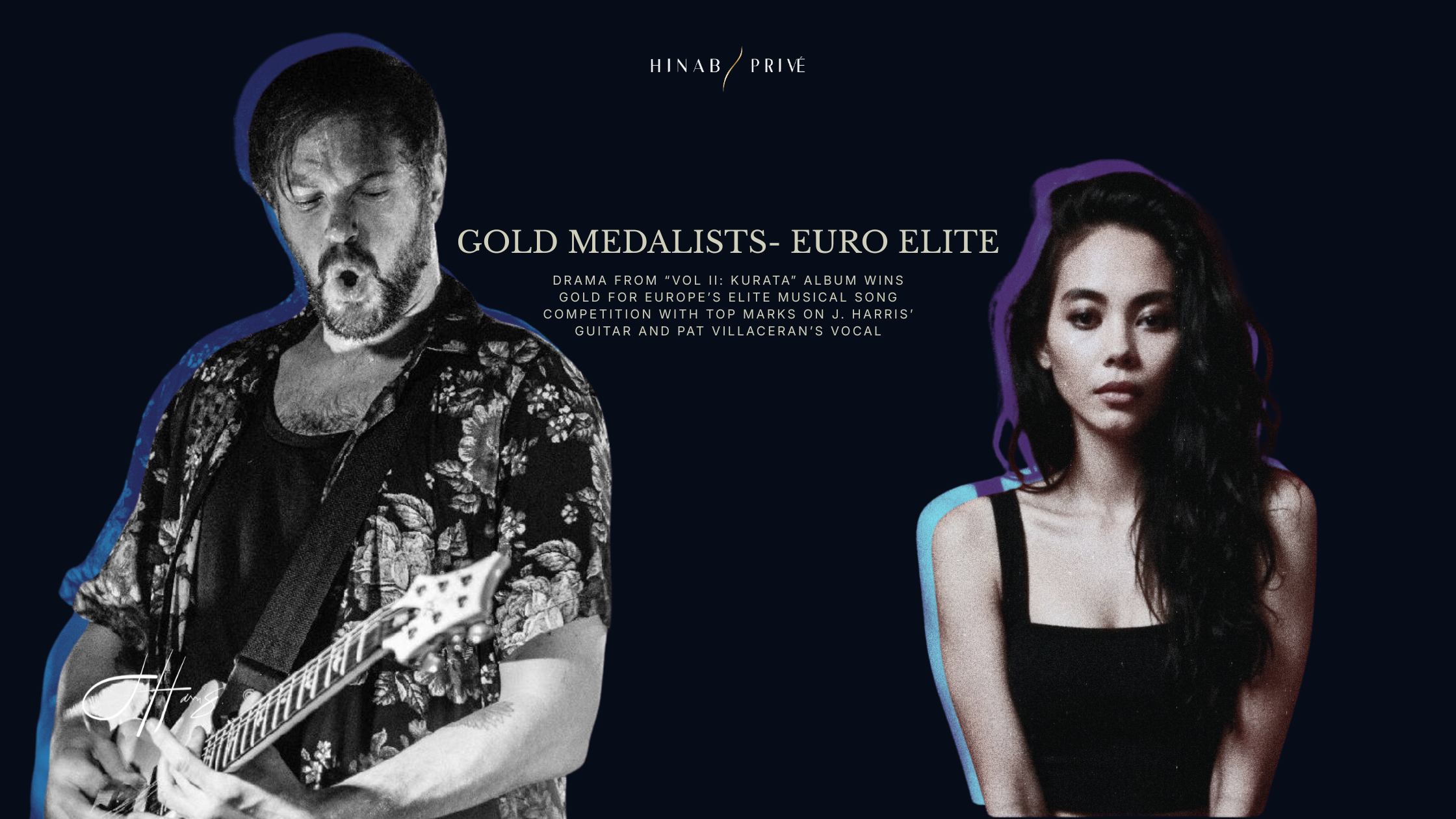
Perhaps the most important context for the award is the partnership behind the song. “DRAMA” is not a solo exercise. It’s the product of a co‑writing and co‑producing relationship between Harris and Pat Villaceran that sits at the heart of Hinabi Privé.
Villaceran brings story and structure: lyrics that treat love, heartbreak, and recovery as serious subjects; an ear for melody that can carry those stories without getting lost in cleverness; and a bigger Hinabi world in which each song has a role to play. Harris brings the sonic architecture: the progressions, textures, and rhythmic decisions that make that story land emotionally.
The gold medal recognises that combination. It implicitly acknowledges that Harris’ guitar and compositional work is at its strongest when it is in conversation with Villaceran’s writing. That’s a powerful bit of feedback in an industry that often tries to extract the “hero” and downplay collaborators.
For Harris, it’s an invitation to lean further into the co‑creation model rather than pulling away from it now that the spotlight is brighter. It suggests that the best version of his sound may be the one that emerges when his instincts are sharpened by another mind – someone who can say, “This progression is beautiful, but here is the emotional beat we’re aiming for,” or “This lyric is strong, what if the guitar under it took three steps back to let it hit harder?”
The award strengthens the case for:
Building future volumes around the Harris–Villaceran axis rather than fragmenting into side projects too soon.
Presenting the live KURATA show as a co‑creation, with Harris as musical director and Villaceran as narrative and vocal lead, rather than defaulting to a conventional “front person and anonymous band” framing.
Inviting other collaborators into a clearly defined ecosystem, where the rules of the world are set by this core partnership.
In a cultural haus like Hinabi, which is already juggling ARCS, apparel, membership, and more, that clarity is invaluable. The medal crystallises the music side: this is the team, this is the sound, this is the standard.
2026: Raising the Floor, Not Just the Ceiling
So what does the gold medal for “DRAMA” really mean for James Harris in 2026?
It means the floor has risen. The baseline expectation – from audiences, from gatekeepers, from collaborators, and from himself – is higher. Every new song, rehearsal, and show will be measured, consciously or not, against a piece of work that a panel of experts judged exceptional.
For a musician with a strong internal compass, that’s less a burden than a sharpened focus. Harris already cared about parts that worked, songs that held together, sounds that served the story. The medal doesn’t change that. What it does change is the environment around him: more opportunities, more attention, more reason to build the live band properly, lean into his own sound unapologetically, and keep co‑creating with Pat Villaceran at full strength.
In other words, the gold doesn’t start his story. It simply marks the moment his story, and the world he and Pat are building with VOL II: KURATA, become much harder to ignore.
