

Why VOL II KURATA Might Be the Most Intimate Cinematic Pop Rock Record You Hear This Year

“Intimate” is one of those words music writers throw around when they mean “quiet” or “stripped-back.” VOL II: KURATA is neither. It’s a cinematic pop rock record that likes its drums resonant, its guitars saturated, and its choruses big enough to swallow a room. The intimacy here comes from somewhere else: the feeling that you’ve been handed a private correspondence between two people who decided to write a love story together across an ocean, then had the nerve to make it loud.
Built by guitarist-composer James Harris and lyricist, co-composer, and Hinabi Privé founder-world-builder Pat Villaceran, KURATA is a three-act album about love, heartbreak, and cautious rediscovery that rarely behaves the way contemporary “heartbreak records” do. Where a lot of modern pop settles for high-drama toxicity and revenge one-liners, this album is preoccupied with quieter questions: who are you when the relationship is over, what kind of person did loving them reveal, and what does it actually mean to rebuild a heart rather than just wall it off.

The architecture is clear without ever feeling heavy-handed. The first arc lives in the immediate aftermath of loss: songs about the first honest inventory of a cracked heart, all jagged edges and half-finished sentences. The middle arc leans into the work of reconstruction, where anger gives way to a tougher kind of grace. The final stretch is the surprise — a set of tracks that imagine love not as a repeat of act one, but as a more mature, more generous thing. It’s concept work in spirit, but it never insists you treat it like homework. You can follow the emotional line if you want; you can also just live inside the songs.
What makes KURATA feel so disarming on first contact is how confidently it refuses to chase trends. There are no obvious TikTok bait sections, no shameless attempts at building a meme-able hook. Instead, Harris and Villaceran return again and again to an old-fashioned assumption: that if you write and record a story with enough care, someone out there will give you forty-odd minutes of their time in one sitting. The record rewards that faith. Played front to back, it moves with a logic that feels closer to film than playlist — by the time you loop back to the beginning, you understand why each song sits exactly where it does.
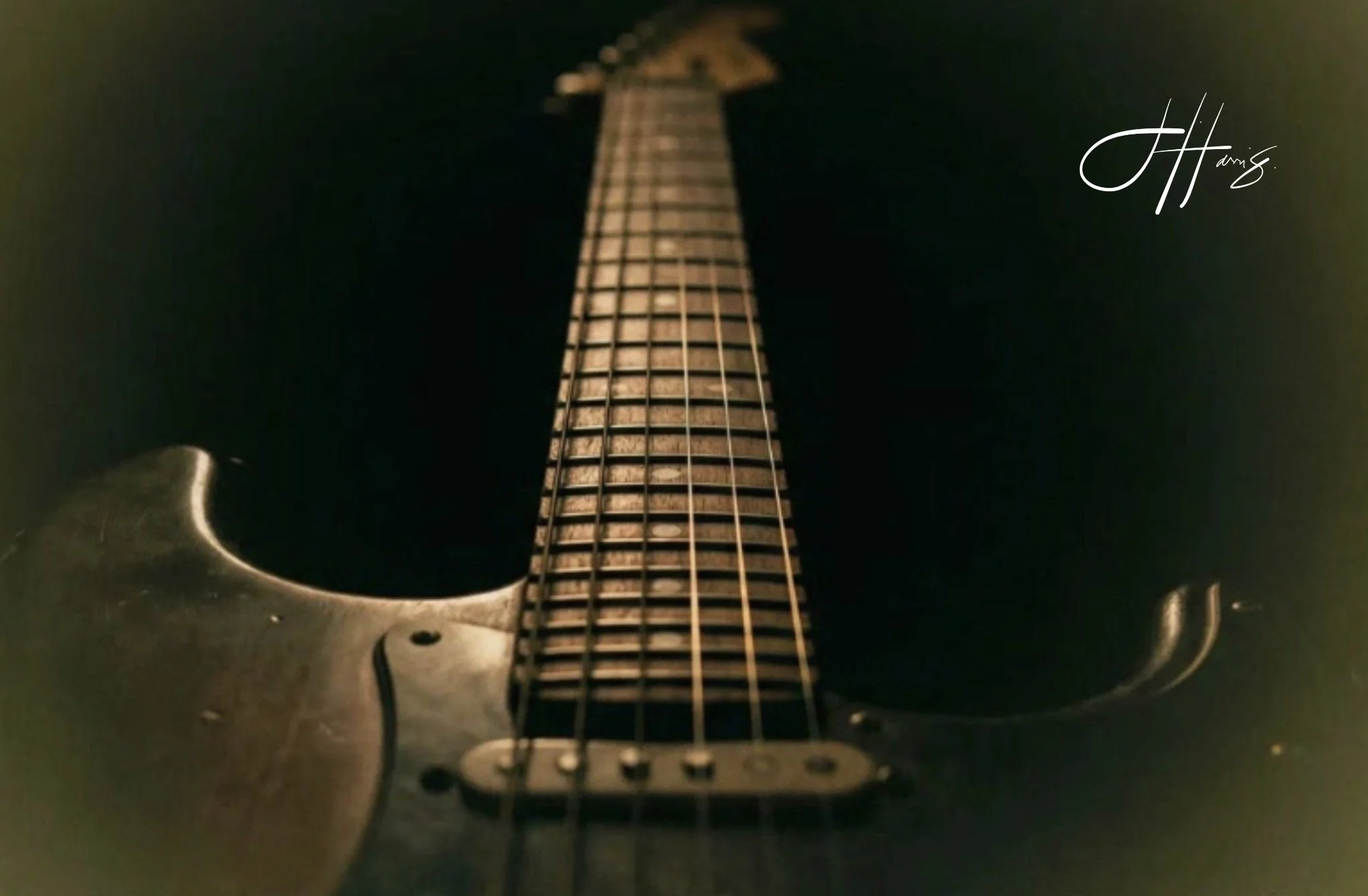
Harris’s guitar work is the gravitational field everything else orbits. His playing is recognisable within a few bars: melodic without being saccharine, muscular without lapsing into aimless shredding. He likes tones that feel like brushstrokes rather than bricks, layering parts so they colour the edges of the vocal instead of fighting it for attention. When the record leans into rock, as on “DRAMA,” “RENEGADE,” or “LUNA,” it hits hard because the guitars have been serving the story all along. The choruses land not as isolated “moments,” but as payoffs.
Villaceran meets that language with lyrics and melodies that are plainspoken but precise. She’s less interested in clever one-liners than in the slow work of naming feelings accurately. Across the album, she keeps circling back to the idea of love as a form of self-revelation: not the neat “I found myself” of a self-help epilogue, but the messier truth that loving someone deeply is often the fastest way to see where you’re still unfinished. The writing is unafraid of softness. There are lines that could easily have been sanded down to sound tougher; the record keeps choosing honesty instead.
That commitment to emotional clarity is part of what gives KURATA its intimacy. The other part is structural. This is an album made across distance: files sent between time zones, stems arriving in the middle of the night, arrangements refined over WhatsApp and cloud folders rather than in a shared studio. You can hear the consequences of that process in the finished tracks. Each idea feels considered in isolation before it’s invited into the room. There’s no sense of musicians fumbling around for something “that might work” in real time. Instead, the songs sound like letters that have been written, re-read, and then finally mailed.
The production leans into that “letter from a world” quality. Synths and piano are used less as decorative touches and more as atmosphere-building tools, wrapping songs in a grain that feels almost filmic. String textures — especially violin — thread through the record as a kind of emotional highlighter, turning up just enough to underline a phrase without tipping into melodrama. Drums sit in a sweet spot between live-room looseness and cinematic precision. It’s easy to imagine almost every track functioning as an original soundtrack cut for a series you’d binge in two nights.
That OST energy is no accident. The album is effectively the sonic backbone of the Hinabi Privé universe, a Manila-based cultural haus that builds live “ARCS” — full-bodied art experiences where music, food, cocktails, textiles, and story are woven together into themed nights. KURATA is one of the scores for that world. You can hear it in the way the songs seem designed to breathe in rooms, to interact with bodies and light rather than just headphones and metrics. There’s a constant sense that these tracks have a second life waiting for them under stage lights and candle glow.
If all this sounds a bit lofty, the record is quick to ground itself in simple pleasures. “DRAMA” is the obvious entry point: a tightly built rock-pop hybrid that understands the value of a big chorus and a drum pattern you can feel in your sternum. “RENEGADE” slows things down and opens them up, a rock ballad that resists the temptation to sprint for catharsis, choosing instead to linger on the unstable moment when you realise you’re not okay and that’s the first honest thing you’ve said in months. “LUNA” takes that emotional groundwork and throws it into motion, a driving single that sounds built for night drives and late setlists.

Elsewhere, the album indulges its cinematic instincts more openly. “BUTTERFLIES” unfolds like a Bond-theme adjacent fever dream, all tension and release, while “WOLFIE” plays with the kind of melodic and harmonic choices that wouldn’t feel out of place in a high-budget animated film. These aren’t genre pastiches; they’re evidence of a pair of writers who understand that “cinematic” is less about string swells and more about giving each song a clear visual axis. You listen and see scenes, not just structures.
Underneath the surface, there are threads of Filipino heritage and identity stitched in quietly rather than waved around. Certain melodic turns, rhythmic emphases, and emotional choices feel rooted in OPM and local sensibilities without ever collapsing into pastiche or name-checking. It’s the same move Hinabi makes in its live work: treating culture as atmosphere and foundation, not costume. For a record that may travel far beyond Manila, that choice gives KURATA a groundedness that keeps it from floating off into generic “global pop” territory.
If there’s a fair criticism to level here, it’s that VOL II: KURATA asks more of its listener than most algorithm-era releases. It doesn’t deliver all of its best ideas in the first ten seconds. It doesn’t tailor itself to skip-proof intros or micro-content. Some of its most affecting moments come in bridges, middle-eights, or late-album turns that people who listen only in shuffle might never reach. But that’s also the point. This is music built on the assumption that some listeners are tired of having their expectations lowered.
Will every person who presses play find it to be “the most intimate cinematic pop rock record” they hear this year? Probably not. But for anyone who still believes albums can be more than bundles of potential singles, VOL II: KURATA makes a strong case. It offers a story that actually goes somewhere, songs that reward attention without punishing casual listeners, and a sonic world distinct enough that, after a while, you start hearing other records through its lens.
Intimacy, here, isn’t about volume or tempo. It’s about proximity to intent: the sense that you’ve been allowed very close to two people who care more about the truth of what they’re making than about whether it fits neatly into a trend cycle. In a year where so many releases will fight to be the loudest, VOL II: KURATA might be the one that sticks because it’s willing to be the clearest.
